CPA-Managed Business Registration · Philippines · DTI · SEC · Tax Authority · LGU
Registered.
Set up right.
The structure you choose today determines your tax exposure for the next decade. Most registration mistakes don't show up in year one. They show up in year four.
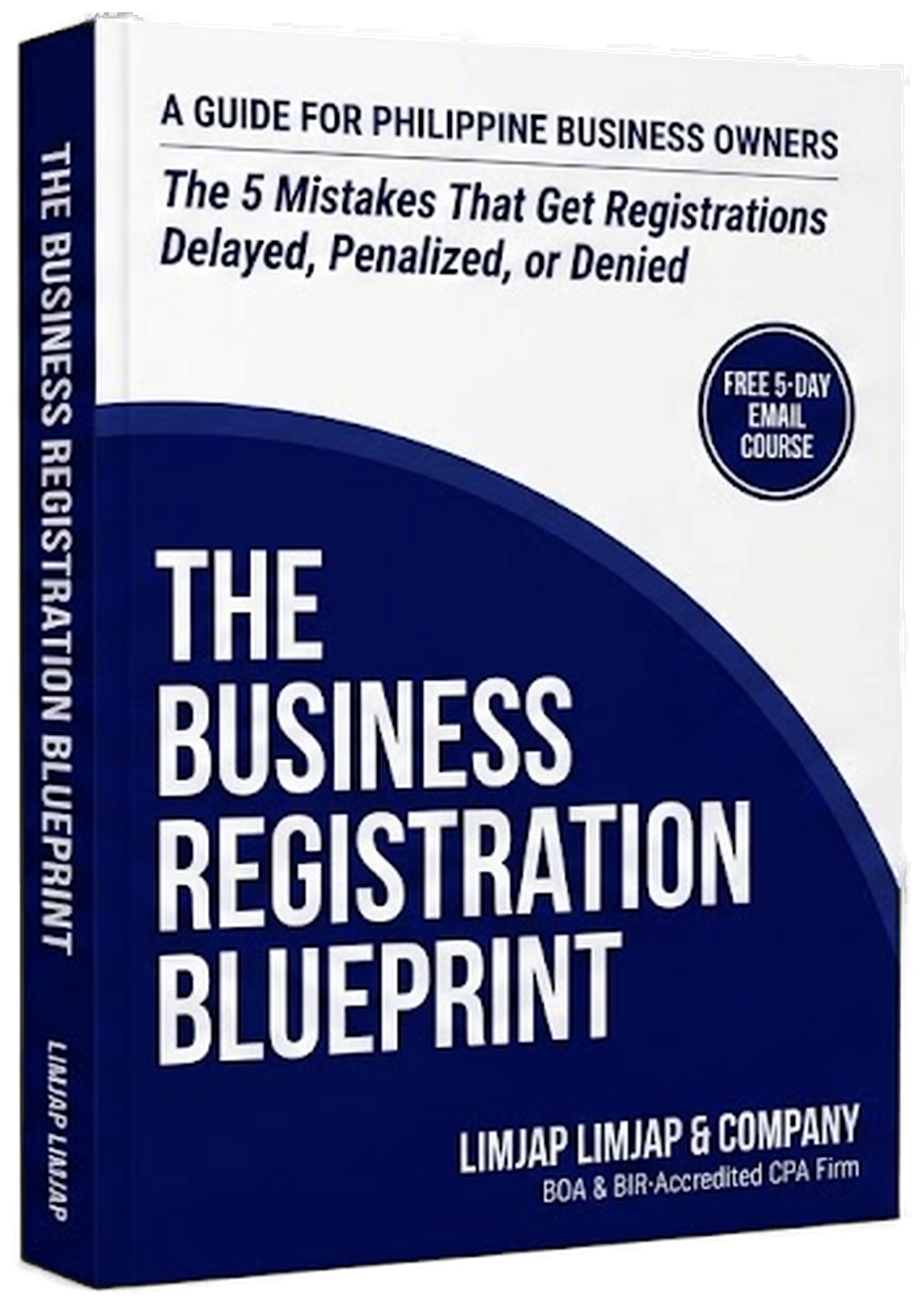
Why Most PH Registrations Get Delayed, Penalized, or Denied
A free 5-day email course exposing the 5 mistakes founders make - even when they already paid someone to "handle it."
Ready to register now? Apply for a consultation →
Common structural errors we encounter
- ✗Sole proprietor doing corporation-level volume - higher tax rates, unlimited personal liability.
- ✗Corporation registered with the wrong tax type - VAT in a percentage tax sector, years of filings the Bureau of Internal Revenue treats as fraudulent.
- ✗registered books of accounts never properly registered - every transaction recorded is technically unofficial.
- ✗Business registered in the wrong barangay - LGU violations that compound annually.
The 4 Agencies
We handle the full registration sequence
Each agency has its own requirements, fees, and processing timelines. We manage all four, in the right order.

Department of Trade & Industry
Business name registration for sole proprietorships - plus structure advice on whether DTI is actually right for your liability and tax position that most owners never get before they file.

Securities & Exchange Commission
Corporations, partnerships, and OPCs: Articles of Incorporation, By-Laws, Treasurer's Affidavit, and SEC i-Register submission - including authorized capital stock structure that affects annual fees and investor capacity.

Bureau of Internal Revenue
Where most self-registered businesses make errors that surface three years later. TIN, VAT vs. non-VAT classification, official receipts, books of accounts, and eBIR enrollment - all configured correctly from day one.

Local Government Unit
Barangay Clearance and Mayor's Permit for Makati, BGC, Quezon City, Pasig, Mandaluyong, and other Metro Manila LGUs. Annual renewal structure included.
Business Structure Guide
Which structure is right for your business?
This is not an administrative decision. It determines how you pay taxes, how you protect personal assets, and how you structure future growth.
Sole Proprietorship
DTI · Best for businesses under ₱3M
You and the business are the same legal entity - simple to register, but unlimited personal liability and graduated income tax up to 35%.
Partnership
SEC · Best for professional groups
Two or more individuals with defined profit-sharing - used by lawyers, doctors, and architects who need formal documentation without full corporate structure.
One Person Corporation (OPC)
SEC · Best for ₱3M–₱30M solo owners
Corporate liability protection for single owners - personal assets stay separate from business obligations, with simpler governance than a multi-stockholder corporation.
Corporation
SEC · Best for ₱30M–₱100M businesses
Multiple stockholders, formal governance, and the most flexibility for ownership, capital raising, and eventual sale - almost always the right structure at ₱30M+.
What's Included
End-to-end registration: all four agencies
We manage the full process so you don't have to restart the clock at any agency from missing documents or wrong sequence.
Pricing
One-time engagement. Done right.
Government fees (DTI, SEC, tax authority, LGU) are billed separately at actual cost.
Sole Proprietorship
₱15,000
DTI + tax authority registration + single LGU. Best for freelancers and small businesses getting started.
OPC or Corporation
₱25,000
SEC + tax authority registration + single LGU. Includes Articles of Incorporation and By-Laws drafting.
Multi-LGU or Complex
₱35,000+
Multiple LGUs, complex structures, or regulated industries with additional agency requirements.
Clients who proceed to an ongoing compliance retainer within 60 days of registration receive a ₱5,000 credit applied to their first month's engagement.
FAQ
Questions about business registration
Requirements vary by structure. DTI sole proprietorship: valid government ID, chosen business name, and business address. SEC corporation or OPC: Articles of Incorporation and By-Laws, Treasurer's Affidavit, proof of office address, and valid IDs of all incorporators. Bureau of Internal Revenue: SEC or DTI Certificate of Registration, proof of business address, valid IDs, and completed application forms. LGU Mayor's Permit: DTI or SEC certificate, Certificate of Registration, barangay clearance, and any industry-specific permits. An accounting firm coordinates the full documentary checklist across all four agencies, reducing back-and-forth and ensuring submissions are complete on the first filing.
DTI online registration: 1–3 business days. SEC online via i-Register: 3–7 business days for OPCs and corporations without complications. Tax authority registration at the Revenue District Office: 5–10 business days after complete documentary submission. LGU Mayor's Permit: 3 days in tech-forward cities like Makati, to 3–4 weeks in municipalities with manual processing. In total, fully registered across all four agencies in 3–6 weeks when documentation is complete and submissions are in the correct sequence. Errors or missing documents at any agency restart the clock for that agency.
Yes. DTI or SEC establishes your legal business identity. Tax authority registration is required to issue official receipts, claim deductible expenses, and file tax returns: operating without it is a criminal offense under the NIRC. LGU Mayor's Permit is required by local ordinance to operate at your business address, and businesses without one face closure orders and are ineligible for Certificate of Registration renewal. The four registrations cover different regulatory jurisdictions and all four must be in place for a fully compliant operation.
Yes, particularly sole proprietorships via DTI's online system. The risk is not in the registration itself: it's in the decisions made during registration. Which tax type should you elect? Should you be VAT or non-VAT? What should your initial chart of accounts look like? Most business owners make these decisions without knowing they're making them, defaulting to whatever the Bureau of Internal Revenue officer suggests or the template used by the previous person in line. The consequences take three to five years to surface. A CPA-managed registration is more valuable because of the decisions made correctly on day one.
Income tax: corporations pay 20–25% on net taxable income; sole proprietors pay graduated personal income tax at 0–35%. VAT: businesses grossing above ₱3M annually must register as VAT taxpayers and collect 12% VAT on sales. Percentage tax: non-VAT businesses pay 3% on gross receipts. Withholding taxes: businesses withhold and remit taxes on employee compensation and on professional fees and rent. Local taxes: LGUs impose local business taxes (typically 0.5–2% of gross sales). The total effective tax burden depends significantly on how the business is structured, which is exactly why structure decisions at registration day matter more than most business owners realize.
The way you register your business determines your compliance architecture for the next decade.
It doesn't cost more to register correctly. The cost is entirely in registering wrong and finding out later.
Apply for a Registration ConsultationNo obligation. You'll know exactly where you stand before we talk next steps.